 +8615515597212
 serena@gelgoog.com

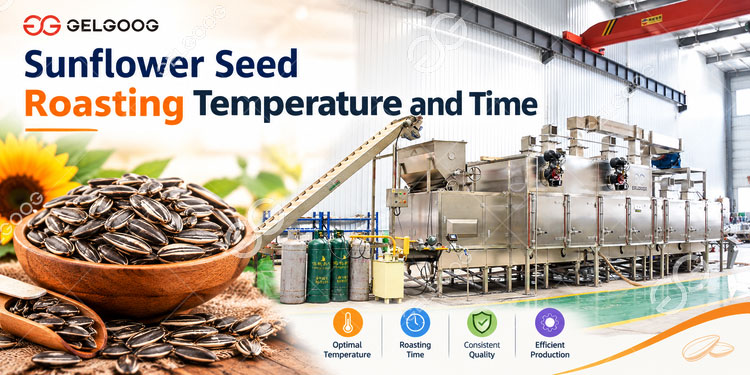
Sunflower Seed Roasting Temperature and Time: Complete Guide
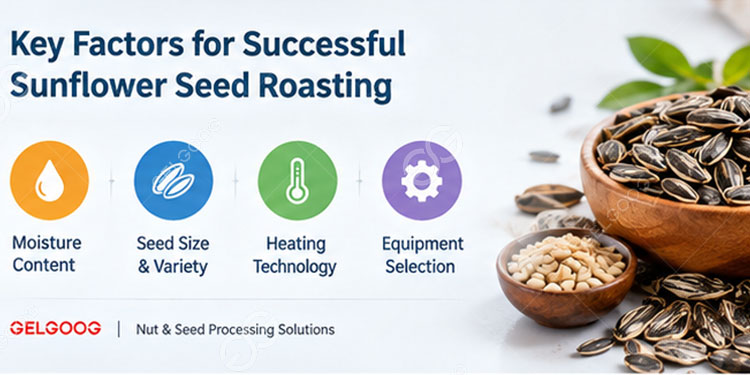
Finding the right sunflower seed roasting temperature and time is essential for achieving consistent color, flavor, texture, moisture, and shelf life. The ideal roasting profile depends on the seed type, whether the product is in-shell or shelled, initial moisture, loading density, heating method, and the desired finished product.
For food processors, selecting the right sunflower seed roasting line is just as important as setting the roasting parameters. A well-designed system should provide stable heat distribution, adjustable residence time, effective cooling, and repeatable process control.
As a digital food-processing solutions provider, GELGOOG helps manufacturers evaluate roasting equipment and develop process configurations according to product characteristics, target capacity, and quality requirements. The temperature and time ranges in this guide should be used as starting points for controlled trials rather than universal production specifications.
What Happens During Sunflower Seed Roasting?
Roasting causes moisture evaporation, flavor development, structural changes, and browning. These changes are influenced by both the heating conditions and the actual temperature reached by the product.
Moisture Loss and Texture
Moisture loss contributes to the crisp texture and storage stability of roasted sunflower seeds. However, the final moisture content and water activity depend on the raw material, pretreatment, roasting method, and cooling conditions. Instead of applying one fixed moisture target to every product, processors should establish specifications through product testing and shelf-life validation.
Flavor and Browning Reactions
Roasted sunflower seed flavor develops through complex thermal reactions, including Maillard reactions and other pathways that generate aromatic compounds. Higher temperatures and longer residence times generally increase browning and roast intensity, but excessive heating can create bitter notes, burnt flavors, and quality deterioration. A controlled roasting profile should balance flavor development with product protection.
Food Safety Considerations
Roasting can reduce microorganisms such as Salmonella, but food safety performance cannot be confirmed by air temperature and residence time alone. Product temperature, initial microbial load, water activity, equipment design, and the complete process must be considered. Certain thermal conditions may also increase unwanted process contaminants, so the final profile should be verified against the requirements of the target market.
Sunflower Seed Roasting Temperature and Time: Starting Ranges
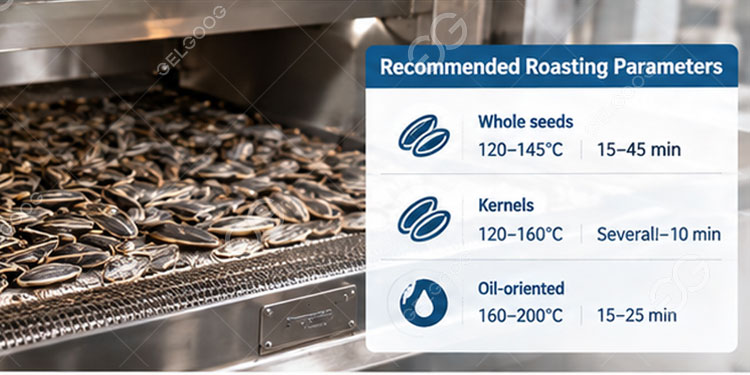
There is no single temperature-time combination that is suitable for every sunflower seed product. The following examples are starting points for trials and should be adjusted based on the actual product and equipment.
Hot Air Roasting
Hot air roasting is widely used in industrial processing because it supports continuous production and adjustable airflow and temperature control. In published research, sunflower seeds have been evaluated at temperatures such as 125°C, 135°C, and 145°C over different roasting periods. The best condition depends on the required flavor, texture, moisture, and color.
- Light roast: Begin with a lower temperature and longer residence time, then evaluate flavor, moisture, and color.
- Medium snack roast: Test a moderate-to-high temperature range with several residence times, for example 160–180°C and 12–20 minutes, depending on product type and equipment.
- Dark or intense roast: Use carefully controlled trials at higher temperatures, monitoring burnt flavor, uneven color, and excessive surface browning.
These ranges are not guaranteed production recipes. The air temperature, seed temperature, belt loading, airflow, and cooling time should be recorded during each trial.
Infrared Roasting
Infrared roasting transfers energy directly to the product surface and may provide fast heating. Its performance depends on radiation intensity, distance, product thickness, surface condition, and exposure time. Because surface heating can be faster than internal heat transfer, processors should verify uniformity and avoid relying only on the equipment setting.
Microwave-Assisted Roasting
Microwave-assisted roasting can change heating behavior and may be combined with hot air to improve surface browning and aroma. However, results vary according to microwave power, product load, moisture distribution, and the design of the combined system. Any claim about shelf-life or peroxide-value improvement should be supported by product-specific testing.
Oil Roasting
Oil roasting uses heated edible oil to transfer heat to the seeds. It can create a distinctive flavor and surface texture, but requires additional controls for oil temperature, oil quality, filtration, oxidation, and fire safety. It is not directly comparable with dry hot-air roasting, so the process parameters should be developed separately.
How Roasting Equipment Affects Temperature and Time
The same nominal temperature and residence time can produce different results on different machines. Equipment configuration directly affects heat transfer, product movement, and roasting uniformity.
Batch Drum Roasters and Continuous Belt Roasters
Drum roasters tumble the seeds during heating and are often suitable for batch or flexible production. Their performance depends on drum speed, loading volume, heat transfer, and mixing efficiency.
Continuous belt roasters move products through a heated tunnel. They can support continuous production and multi-zone control, but belt speed, layer thickness, airflow distribution, and loading density must be adjusted carefully. GELGOOG’s sunflower seed roasting machine can be evaluated according to the required product, capacity, and process configuration.
The Role of PLC and Multi-Zone Heating
A PLC-based control system can help operators manage temperature, belt speed, residence time, alarms, and recipe settings. Multi-zone heating allows the roasting profile to be adjusted along the tunnel. Nevertheless, PLC settings do not replace process validation: the actual product temperature and finished-product quality must still be measured.
How to Optimize Sunflower Seed Roasting Temperature and Time
Step 1: Define the Product and Target Quality
Clarify whether the product is in-shell or shelled, salted or unsalted, intended for direct consumption or further processing, and whether the target is a light, medium, or dark roast. These factors influence the required process profile.
Step 2: Record Raw Material Conditions
Measure or document incoming moisture, seed size, variety, pretreatment, and initial temperature. Differences in raw material conditions can lead to different heating and drying results.
Step 3: Establish a Trial Matrix
Select a practical starting temperature and test several residence times, or select a residence time and test several temperatures. Change one major variable at a time where possible. Record air temperature, product temperature, belt speed, loading density, color, moisture, water activity, texture, and sensory results.
Step 4: Verify Food Safety Separately
Published research on dry-roasted sunflower seeds evaluated Salmonella inactivation at specific conditions, including 135°C for different roasting times. The study reported an estimated 5-log reduction at 135°C for 19.2 minutes under its experimental conditions, while a longer process was required to reach the study’s reported saleable water-activity range. These results should not be copied directly as a validated recipe for another machine or product.
For commercial production, establish a documented validation procedure with qualified food-safety personnel. Use calibrated instruments and consider product temperature, water activity, microbial testing, and the applicable regulatory requirements. Do not claim that a particular temperature and time guarantees food safety without process-specific validation.
Step 5: Validate at Production Scale
Pilot-scale results may change after scale-up. Check whether the production machine maintains consistent airflow, layer thickness, belt loading, heating-zone temperature, and cooling performance. Test samples from different positions and different points in the production run.
Step 6: Create and Monitor Recipes
After validation, store approved recipes in the control system. Each recipe should include product type, raw material requirements, temperature settings, belt speed or residence time, loading conditions, cooling parameters, inspection frequency, and acceptance criteria.
Troubleshooting Common Roasting Problems
Uneven Roasting
Check product distribution, layer thickness, airflow, heating-zone balance, and mixing or belt movement. Overloading the machine can reduce heat transfer and create inconsistent color.
Burnt or Bitter Flavor
Reduce excessive heat exposure, review the final heating zone, and check for carry-over cooking during transfer and cooling. Inspect whether the product is accumulating near hot surfaces.
Soft or Insufficiently Dried Seeds
Check initial moisture, residence time, airflow, loading density, and cooling conditions. Measure final moisture and water activity rather than judging dryness by appearance alone.
Rapid Rancidity
Review roasting severity, cooling efficiency, oxygen exposure, packaging, storage temperature, and oil quality where applicable. Shelf-life performance should be confirmed through appropriate stability testing.
Frequently Asked Questions
What is the best temperature for roasting sunflower seeds?
The best temperature depends on the seed type, roasting method, raw material condition, and desired finished product. Start with controlled trials and evaluate product temperature, moisture, color, flavor, texture, and safety requirements.
How long should I roast sunflower seeds at 180°C?
A residence time such as 12–20 minutes may be used as a trial range for some snack-roasting applications, but the correct time depends on the product and machine. Confirm the result through testing instead of applying a fixed time to every process.
Does temperature or time matter more?
Both matter. Temperature affects heat-transfer intensity and thermal reactions, while residence time determines the total exposure. Product temperature and water activity are also important verification indicators.
Can I use the same settings for in-shell and shelled sunflower seeds?
Not necessarily. The shell changes heat transfer, moisture movement, and the time required to achieve the target quality. Develop separate profiles when the product structure is different.
How can I validate Salmonella reduction?
Use a documented, product- and equipment-specific validation process. Published research can provide useful reference information, but a research condition should not be treated as a universal commercial guarantee. Consult qualified food-safety professionals and follow the requirements of the target market.
Conclusion: Develop a Consistent Sunflower Seed Roasting Process with GELGOOG
Optimizing sunflower seed roasting temperature and time requires more than choosing a number on the control panel. A reliable process combines suitable equipment, stable heat transfer, accurate residence-time control, effective cooling, product testing, and documented validation.
GELGOOG provides food-processing equipment and customized roasting solutions for sunflower seeds, peanuts, pumpkin seeds, and other products. Our team can help evaluate roasting line configuration, production capacity, temperature control, belt speed, and supporting equipment according to your process requirements.
Need help selecting a sunflower seed roasting machine?
Contact GELGOOG to discuss your product, capacity, roasting target, and factory conditions. Our engineers can recommend a suitable solution and help you plan the next testing steps.

Leave a Reply